You Can't Plug In a Cement Plant
Analysis · THE BUILT ENVIRONMENT'S CARBON PROBLEM · PART 2 OF 6
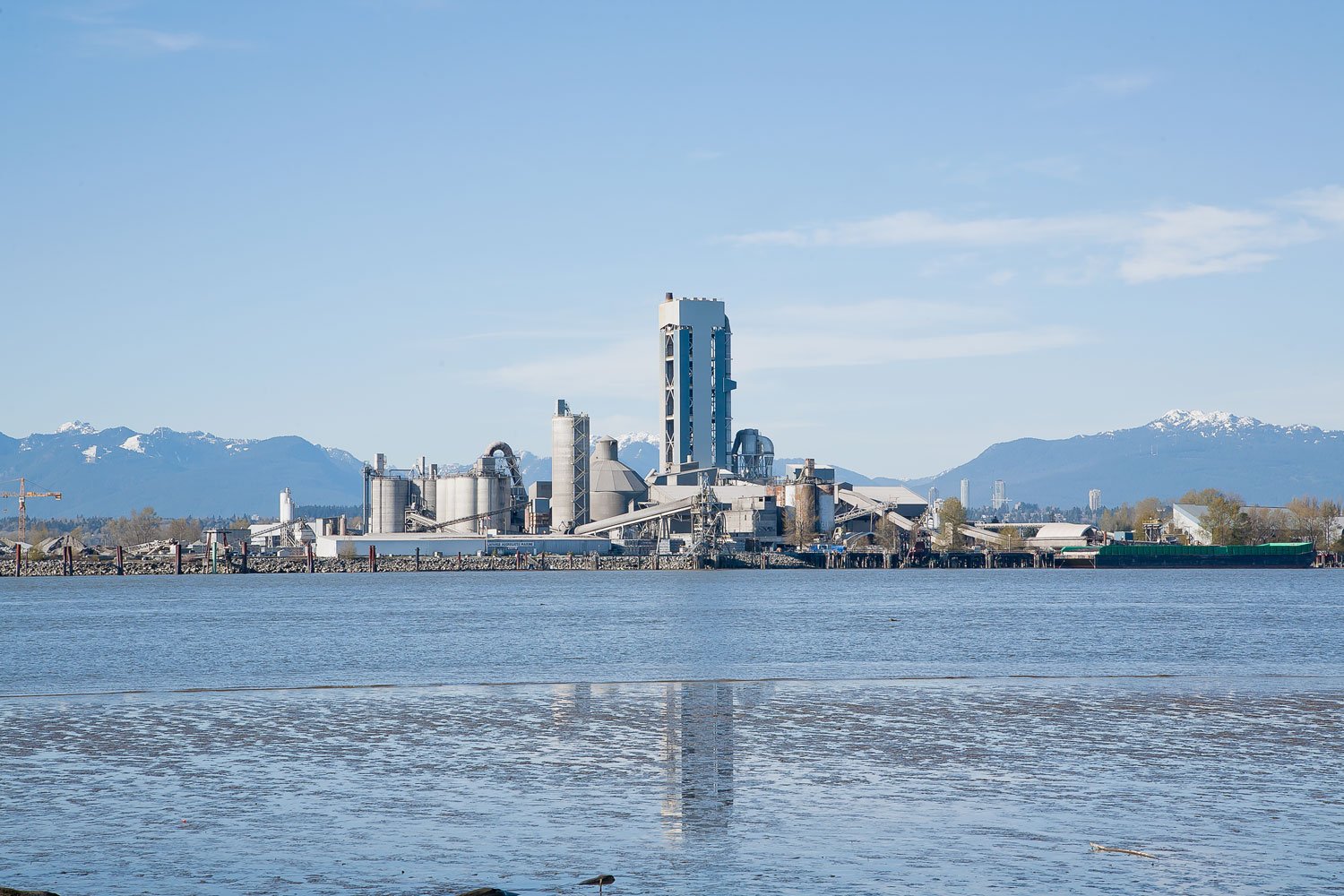
Lafarge Canada Cement Plant, Richmond, BC
Part 1 split building emissions into two kinds: operational, from running the building, and embodied, from making its materials. Embodied is the half that’s growing — about a quarter of sector emissions today, roughly half by 2050. When the grid gets cleaner, operational carbon drops. Embodied carbon mostly doesn’t, and that comes down to how these materials get made.
Cement, steel and aluminum in buildings put out around 2.1 Gt of CO₂ in 2024 — about 9% of the global total, and flat since 2015. The reason it won’t budge: these materials give off CO₂ two ways, from the energy used to make them and from the chemical reactions themselves. Clean electricity only fixes the first one.
Cement: the carbon is in the recipe
Cement is roughly 8% of global CO₂ by itself, and concrete is the most-used material on earth after water. Nearly all of that carbon comes from making clinker, and the problem is built into how clinker forms. You heat limestone and it breaks down into lime and CO₂. That reaction called calcination, accounts for approx 60% of cement’s emissions, and it happens no matter what fuel runs the kiln. The fuel adds the other 40% or so.
Electrifying the kiln only removes the fuel emissions. The 60% from the reaction is still there, and the only way to get rid of it is to capture the CO₂ as it comes off the kiln. The first industrial-scale plant doing that — Heidelberg’s Brevik in Norway which came online in June 2025, and it captures about half its emissions at $144–215 a tonne.
Steel: coal does two jobs
Steel is the same trap with a different reaction. About 70% of the world's steel still comes from the blast-furnace route, where coking coal pulls double duty — it's the fuel, and it's the chemical that strips oxygen off iron ore. That reaction gives off CO₂ directly, roughly 1.9 tonnes for every tonne of steel. Recycled scrap in an electric-arc furnace runs about 1.1 tonnes, some 55% less, but there's only so much old steel around to melt, so scrap can't cover new demand. The clean primary route swaps coal for hydrogen — it works in Swedish and German pilots and could be cost-competitive before 2030, but it's a rounding error in supply right now, and steel's emissions still haven't fallen.
Why a clean grid can't fix it
A cleaner grid does work on the operational side. Building operational emissions rose only 6.5% from 2015 to 2024 while energy demand climbed about 11%, because more renewables and less coal broke the link between the two. Embodied carbon doesn't get that benefit, because the process emissions from cement and steel aren't combustion. A country with a spotless grid doesn't end up with cleaner concrete — cleaning up the power just makes the embodied share more visible, since the operational side has already come down. That's why this shows up first in the greenest markets.
Even the substitutes hit walls
The usual way to cut concrete's carbon is to swap some clinker for supplementary cementitious materials — mostly fly ash from coal plants and slag from blast furnaces. They can take up to ~50% off a mix, and they've been cheap because they're basically industrial waste. The catch is where they come from: coal power and blast-furnace steel, the exact industries we're shutting down, so their supply is drying up too. EU modelling has fly ash falling from 8.5 Mt in 2025 to under 2.7 Mt by 2035 and near zero by 2045, with slag on the same track. The cheap fix goes away right as everything else cleans up.
The alternative that does scale is LC3 — limestone calcined clay cement — which replaces up to half the clinker with clay and limestone and cuts CO₂ by 30–40%. Clay is abundant and isn't a byproduct of anything, so it doesn't hit the same supply wall. Timber helps too, around 30% lower than concrete and up to ~45% over a full life cycle, but there's a ceiling on it: all the mass timber the US used in 2023 added up to a single sawmill's annual output. It works for low- and mid-rise buildings, but it can't replace concrete and steel at global scale.
What this means if you build or own
For anyone holding a project, you can't green-power your way out of embodied carbon the way you can with operational carbon. It's decided upstream, at specification — the cement mix, the structural system, whether you reuse a frame instead of pouring a new one. Once the material is cast or rolled, that carbon is locked in for the life of the building.
That's a money and timing problem. Low-clinker cement and recycled steel come with different prices and availability, captured "green" cement is expensive and barely exists yet, and the cheap SCM route is running out. In the fastest markets it's already turning from choice into compliance — a number of European jurisdictions and some North American cities now cap or require reporting on embodied carbon for larger buildings. The owners who treat material choice as a design-stage financial call, instead of a box to tick at the end, are the ones who won't get stuck paying for it later.
Part 3 leaves the chemistry behind and looks at why these emissions stay stuck, even though most of the technology to cut them already exists. The answer has more to do with how the industry works than with the materials.
Sources
UNEP / GlobalABC — Global Status Report for Buildings and Construction 2025–2026
WRI — Laying the Foundation of Cement and Concrete Decarbonization
npj Materials Sustainability (2025) — Electrification Technologies for Sustainable Cement Production
MDPI Clean Technologies (2025) — Decarbonizing the Cement Industry
ACS Environmental Science & Technology (2025) — Cement Industry Decarbonization at Scale
White & Case (2025) — Constructing the Green Steel Ecosystem
Arthur D. Little (2025) — Paving the Way to Net Zero: The Future of Green Steel
Global Cement (August 2025) — Update on Supplementary Cementitious Materials in the US
MDPI Sustainability (2025) — Limestone Calcined Clay Cement (LC3)
Nature Communications (2025) — Global Land and Carbon Consequences of Mass Timber Products